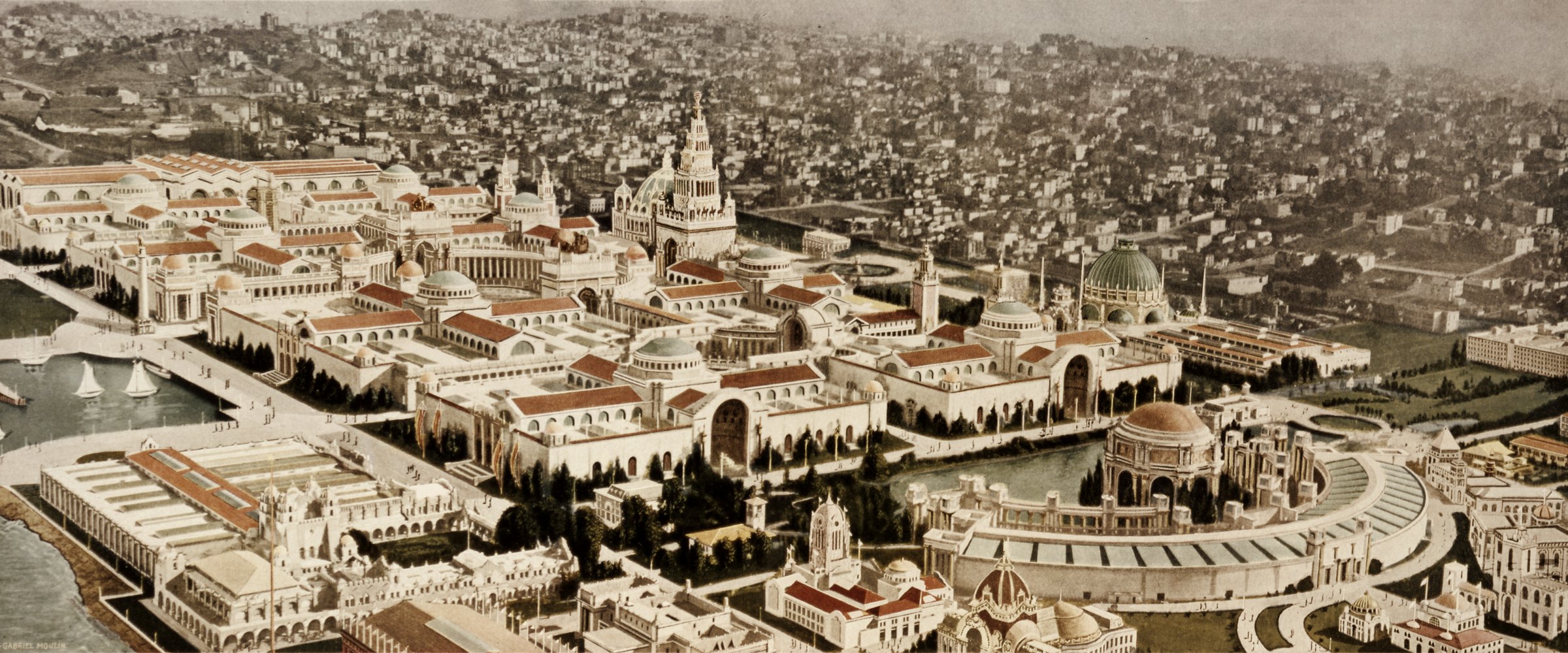
 Aeroplane view, 1915
288 Days
Nine years after the earthquake and fire, San Francisco built a city of domes on the edge of the Bay to celebrate the Panama Canal, lived in it for 288 days, and then tore nearly all of it down. This is the history of the Jewel City, a reconstruction you can walk through, and a film.
A world's fair that looked like a picture in three dimensions
The Panama-Pacific International Exposition filled 635 acres of reclaimed marsh between the Presidio and Fort Mason, on the ground that is now the Marina District. Eight exhibit palaces stood shoulder to shoulder inside one continuous wall of imitation travertine, opening onto courts full of sculpture, fountains and gardens. Over all of it rose the Tower of Jewels, hung with more than a hundred thousand pieces of cut glass.
Its planners wanted one harmonious whole rather than a scatter of competing buildings. Jules Guérin chose every color, from the terra-cotta domes to the pink of the flagpoles. At night W. D'Arcy Ryan hid the lights and floodlit the walls instead, something no earlier fair had done at this scale. Almost nineteen million admissions were counted before the gates closed on December 4, 1915. Only Bernard Maybeck's Palace of Fine Arts still stands where it was built.
Walk the fair, fly over it, stay for the illumination
The reconstruction places each building where the 1915 U.S. Geological Survey map shows it and sizes it from the dimensions in the Official Guide and the official history. The street grid, the shoreline, Alcatraz, Angel Island and the Marin hills are where they really are. The sun follows San Francisco's actual path through the sky, and after dusk the illumination comes on: floodlit walls, glittering jewels on the Tower, and the Scintillator's forty-eight searchlights sweeping over the Bay.
- Take a guided tour from the Scott Street gate to the evening light show.
- Walk at eye level through the Court of the Universe.
- Click any building to read its history.
288 Days
A feature-length film of the whole story, from the burned city that dreamed it up to the wreckers who took it down, told in period photographs and film, the 3D reconstruction and recordings of Sousa's Band.
Photograph the fairground
We are asking photographers of every level, phone or camera, to stand where the 1915 fair stood and send the picture. Every photograph that plays in the film carries the credit its maker asks for, for as long as the film exists.

One-sheet, 27 × 40 in. Poster to come: drop assets/poster-288-days.jpg in place and it appears here.

Front cover, 6 × 9 in. Cover to come: drop assets/book-288-days.jpg in place and it appears here.
The poster and the book
The documentary gets a one-sheet, and the story of the Exposition, the chapters on this site expanded and illustrated with the fair's own photographs, becomes a book. Both are in the works; the frames are waiting for them.
The story of the Exposition
Long-form chapters drawn from the Official Guide, Frank Morton Todd's five-volume official history, and the fair's own books, maps and photographs.
Palaces, courts and pavilions
Tower of Jewels
The 435-foot centerpiece of the fair, a Roman arch-and-tower hung with some 102,000 glass 'Novagems' that shook in the wind and blazed under searchlights at night.
Palace of Fine Arts
Maybeck's dreamlike ruin of a Roman temple, set behind a lagoon, and the one exposition building that still stands on the site, rebuilt in concrete in the 1960s.
Court of the Universe
The ceremonial heart of the fair: a vast elliptical court of double colonnades, sunken gardens and colossal sculpture where the Nations of the East met the Nations of the West.
Palace of Horticulture
A glass-domed conservatory in a garden-party costume: Byzantine in outline, French in its lattice and garlands, lit at night by searchlights turning inside the dome.
Festival Hall
The exposition's green-domed concert hall in the French theatrical manner, home to one of the largest organs in America and a year of choruses, orchestras and recitals.
Palace of Machinery
The Roman-scaled timber giant at the east end of the main axis, the largest building at the exposition, where Lincoln Beachey flew the first airplane ever flown indoors.
Court of Abundance (Court of Ages) and the Tower of Ages
Mullgardt's dark, dramatic east court, a Spanish-Gothic fantasy on the ascent of man, crowned by the 219-foot Tower of Ages and lit at night by gas-breathing serpents and red fire.
The Zone
A 65-acre amusement city strung along one 3,360-foot street from Fillmore to Van Ness, the largest midway any exposition had yet built.
The End of the Trail
Fraser's image of an exhausted Native rider at the edge of the Pacific, the most popular sculpture at the fair and a lasting symbol of the 'vanishing race' idea.
California Building (California Host Building)
The Exposition's official host building, a vast Mission-style complex of towers, patios and county exhibit halls on the bay shore, covering about five acres.
Oregon Building
'A Parthenon with the bark on': 48 unpeeled Douglas-fir logs, one for each state, standing in for the marble columns of Athens.
French Pavilion (Palace of the Legion of Honor)
A replica of the Paris Palais de la Légion d'Honneur, built in nine weeks amid the war, later the model for San Francisco's Legion of Honor museum.
The first exposition with a single color scheme
The Official Guide lists the colors Guérin allowed. French green was used for garden lattices and deep cerulean blue for recessed panels and vaults. Flagpoles were orange-pink, and the backgrounds of the colonnades a pinkish red with a dash of brown. Small domes and mouldings were golden burnt orange, the large domes terra cotta. Statuary was gold and urns verde antique. The walls were an old-ivory tint modeled on Roman travertine.
Timeline, 1904–2015
From R. B. Hale's letter proposing a fair to the centennial, date by date.
Visiting the site
A walk through the Marina District, tracing where the palaces, courts and the Zone stood.
Sources
The period guides, histories and photograph collections this site is built on. Most are free to read online.